Waking up to a garage door that won’t open is more than just an inconvenience; it can disrupt your entire day and compromise your home’s security. While regular maintenance can prevent many issues, mechanical failures often happen at the worst possible times-late at night, on weekends, or during holidays.
If you are reading this because your door is currently stuck, do not force it. Read the safety steps below immediately.
1. What Qualifies as a “True” Emergency?
Not every squeak or rattle warrants a late-night dispatch fee. However, certain situations demand urgent professional attention to prevent injury or significant property loss.
- Vehicle Entrapment: If your car is trapped inside and you need to get to work or a medical appointment, this is the #1 reason for emergency calls. Note: If the spring is broken, you cannot simply “pull the red cord” to lift it (see Safety Warning below).
- Security Vulnerabilities: A door stuck halfway open is an invitation to intruders and raccoons. It also leaves your home exposed to rain, snow, or freezing temperatures that can damage pipes in the garage.
- The “Hanging” Door: If a cable has snapped or the door has jumped the track and is hanging at an angle, it is a “guillotine” hazard. Do not go near it. Gravity can pull the heavy steel panels down instantly.
2. The Cost of Emergency Service
One of the most common questions is, “How much extra will this cost?” Transparency is key here.
- The “Emergency” Fee: Most reputable companies charge a “dispatch fee” or “emergency service call” fee that ranges from $100 to $200 on top of the repair cost. This pays for the technician to leave their home outside of business hours.
- Standard Repairs: Once the technician arrives, the repair costs are typically standard.
- Broken Spring: $150 – $350 (most common emergency)
- Snapped Cable: $85 – $200
- Off-Track Repair: $125 – $300
Tip: If your car isn’t trapped and the door is closed securely, waiting until 8:00 AM can often save you that $100+ emergency fee.
3. DANGER ZONE: The Broken Spring
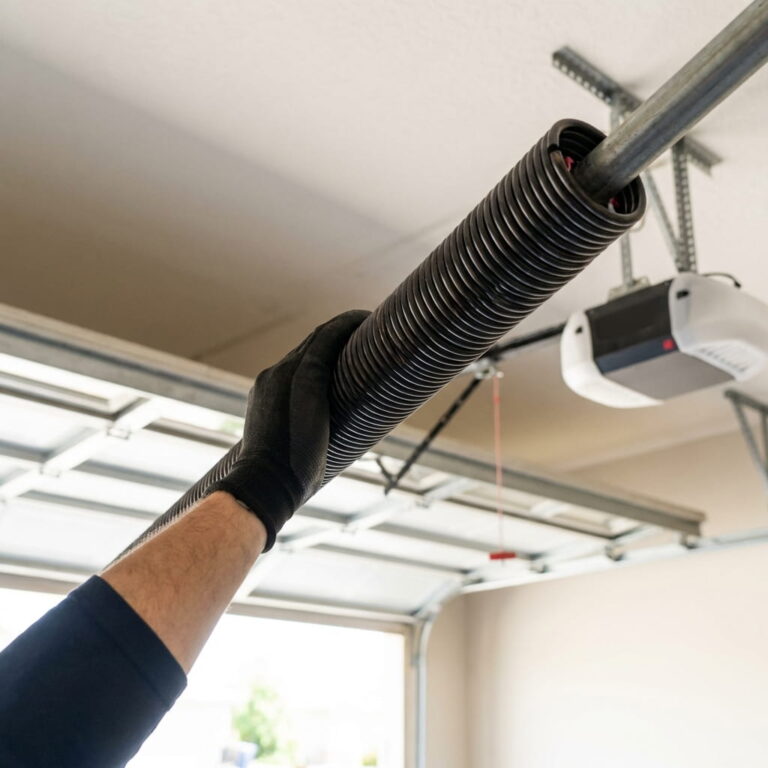
If you heard a loud “BANG” like a gunshot or firecracker, your torsion spring has likely snapped.
- The Danger: The spring holds 100% of the door’s weight (often 200–400 lbs). Without it, the opener cannot lift the door.
- The Mistake: Many homeowners pull the Red Emergency Release Cord thinking they can lift the door manually. DO NOT DO THIS. Without the spring’s help, the door is “dead weight.” If you disconnect the opener while the door is open, it could come crashing down, crushing anything underneath.
4. What to Do While You Wait
After you call for service, follow these steps to secure the scene:
A. The “Clamp” Method
If your door is stuck partially open and you cannot close it:
- Unplug the Opener: Prevent the motor from burning out if a family member accidentally hits the button.
- Block the Gap: If the door is stuck 6 inches off the ground, place a 2×4 or sturdy object underneath (without standing under it!) to prevent it from sliding further down.
- Clamp the Track: If you have C-clamps or Vise-Grips, clamp them onto the vertical track below the roller. This acts as a physical brake to stop the door from falling.
B. Clear the Zone
If a cable has snapped, it can whip around with incredible force. Keep children and pets entirely out of the garage until the technician gives the “all clear.”
5. Prevention: Avoid the 2 A.M. Wake-Up Call
Most emergencies give warning signs weeks in advance.
- The “Jerky” Motion: If your door shudders or shakes on the way down, your rollers are worn or the track is dirty.
- The “Groan”: A loud groaning noise usually means the springs are dry and rusting. A rusted spring is a ticking time bomb.
- The “Sag”: Disconnect the opener (when the door is closed) and lift the door halfway by hand. If it slams back down, your springs are weak and nearing failure.
Frequently Asked Questions (FAQ)
Q: Can I open my garage door with a broken spring? A: We strongly advise against it. The door is extremely heavy. Lifting it requires two strong adults, and if you let go, it will slam down, potentially breaking the glass or bending the panels.
Q: How long does an emergency repair take? A: A professional technician keeps their truck stocked like a warehouse. A standard spring or cable replacement typically takes 45–60 minutes once they arrive.
Q: Will homeowners insurance cover this? A: Generally, no. Wear and tear (like a broken spring) is not covered. However, if a driver accidentally backed into the door (impact damage), your auto or home insurance might cover the replacement.